


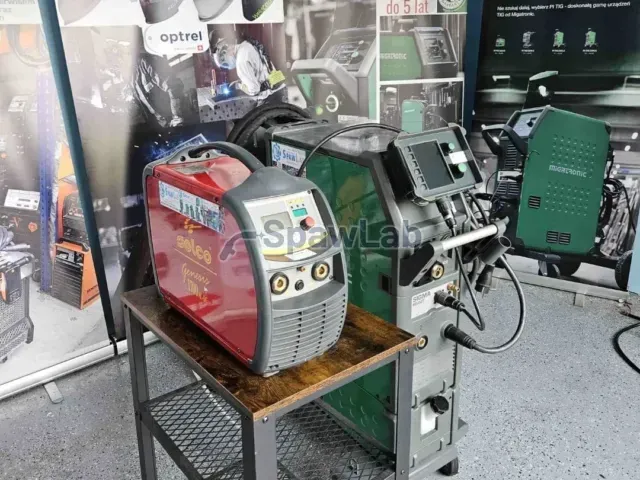


The Lorch HandyTIG 200 AC/DC is a portable inverter TIG power source for alternating and direct current, supplied from a single phase 230 V socket. It gives 200 A at a 45% duty cycle, 180 A at 60% and 160 A at 100%, and the control starts from 10 A. The module itself weighs about 13.4 kg, and in this set it stands on a Lorch trolley with an external liquid cooling module.
What this machine is for
Alternating current takes aluminium and light alloys. In the phase with reversed polarity the cleaning wave breaks up the layer of aluminium oxide, and in the return phase the heat goes into the bare core of the material, so the penetration is even. Direct current answers for stainless, acid resistant and mild steel, and for copper and titanium as well. A current of 200 A at a 45% duty cycle gives a reserve for thicker walls, while 160 A in continuous work lets you pull long runs without breaks.
The documentation aims this model at fitters of sanitary installations, workshops making railings, services for aluminium frames and maintenance departments. A supply from one phase and a weight of about 13.4 kg mean that you take the source onto a building site and to work at height. The housing is prepared for that way of working, the maker declares safe falls from a height of up to 60 cm, and under the cover sits a dust filter.
The third method is a covered electrode from 1.5 to 4.0 mm in diameter. It comes in useful on fast corrections in wind and in a trench, where the gas shield blows away, and also on repairs of construction and farm machines. The uses listed are the welding of aluminium alloys in light frames, the joining of tanks under liquid cooling, hygienic joints for pharmacy with HF ignition free of tungsten, yacht rails and chrome nickel parts run with pulse, and series metalwork on saved programs, where the same machine runs on two shifts and every operator is to call up the same settings.
Features and equipment
- Alternating current AC for aluminium: the circuit turns the polarity round over and over, the cleaning wave takes the aluminium oxide off, and you match the cleaning balance to how dirty the material is.
- Direct current DC: stainless, acid resistant and mild steel, with a smooth run of the pool and no discolouring on the face. The control range starts from 10 A, so you go down to thin sheet and to small parts as well.
- The ControlPro panel worked in three steps: you point to the material, that is AC for aluminium or DC for steel, you pick the current and the way of ignition, and the controller sets the profile of the rise of the wave and the gas flow at the end. A new crew learns the operation in a few minutes, but a practised welder has fewer corrections by hand than on a panel with a full list of sliders.
- Job Mode memory: two places for TIG programs and two for the covered electrode, with a record of the balance of the half wave for aluminium and of the proportion between base and peak in the pulse. Four slots are not many, and rare recipes you note down outside the machine.
- Contactless HF ignition: a high frequency pulse gets over the gap between the electrode and the material, so the arc lights with no touch and with no tungsten inclusions in the weld.
- 2T and 4T modes: in four step the arc burns after a short press of the button, which spares the forearm on long circumferential welds on tubes and helps to add the rod evenly. In two step you have a faster end when you need to break the run by hand.
- Pulse: the current goes between a holding value and a pulse that presses the drop into the groove, so the thin walls of chrome nickel tubes do not fall in and the face lays out in an even ripple.
- MMA mode with Hot Start and Anti-Stick: Hot Start raises the current at the start and settles the ignition on rusty material, Anti-Stick cuts the voltage at a short circuit, before the electrode locks in the pool.
- Housing with Crash Protection: the power modules sit in a steel and polymer housing, and mechanical stress absorbers separate the boards from the shocks of knocks against stairs and scaffolding.
- Dust filter on the air intake: the membrane holds steel filings back from the heat sinks, and a hinged polycarbonate pane closes the desk around the potentiometers. The filter needs cleaning, because a blocked one chokes the fan and ends with a thermal fault.
- External liquid cooling module on the trolley: the pump pushes the fluid into the 4 m cable pack and brings the temperature of the torch down at work above 150 A and on aluminium on alternating current, where the arc gives the most heat into the grip. The basic version of this model gives the heat off through gas from the cylinder, and this unit has a frame with a water section, which lengthens the time of work without breaks but ties the source to the station.
Technical data
| Brand | Lorch |
|---|---|
| Type | inverter TIG AC/DC power source with an MMA mode |
| Supply voltage | 230 V, single phase |
| TIG welding current range | from 10 to 200 A |
| Current at a 45% duty cycle | 200 A |
| Current at a 60% duty cycle | 180 A |
| Current at a 100% duty cycle | 160 A |
| Reference temperature of the cycles | 40 degrees C |
| Type of current | AC/DC |
| Weight of the main module | about 13.4 kg |
| Dimensions | 480 x 185 x 326 mm |
| TIG arc ignition | contactless HF |
| MMA electrodes handled | from 1.5 to 4.0 mm |
| Cooling given on the record | gas |
| Torch cooling in this set | liquid, external pump on the trolley |
| Cable pack | 4 m |
| Resistance of the housing per the maker | a fall from a height of up to 60 cm |
What you get
- Lorch HandyTIG 200 AC/DC source with the ControlPro panel
- Lorch wheeled trolley with a liquid cooling section
- 4 m cable pack with a liquid cooled torch
- external pump of the cooling circuit
What to watch out for
The product record gives gas cooling and the source description a set with a trolley and a liquid circuit, so confirm the configuration at collection. A single phase supply does not like long extension leads, at the upper settings the voltage drops and the arc breaks, so take the cross section of the core with a margin. The trolley with the pump raises the weight of the station and calls for even ground for the circuit of the fluid to work properly, while the source itself stays portable and you take it off the frame. HF ignition scatters interference, so do not start it next to numerically controlled machines.
Before you decide, look at the torch and the consumable parts, that is the nozzle, the collet and the tip, check the state of the filter sponge and the level and the strength of the fluid in the circuit. The memory covers four programs, and with a larger number of repeatable joints keep your own notes.
This unit is sold
This machine has already gone to a customer. Similar units are listed below, and if you want the same model, leave your contact details in the form and we will let you know when the next one arrives.