
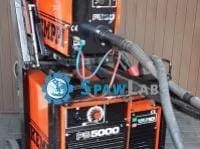
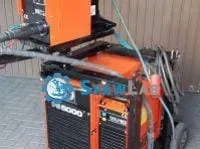
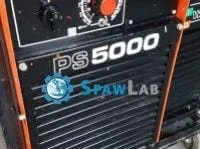
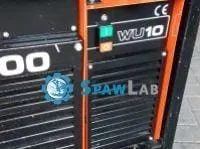
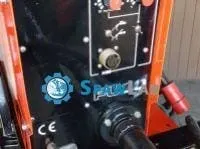
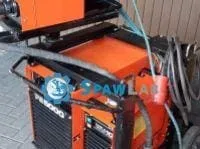
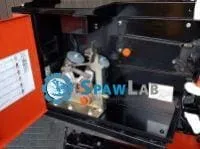
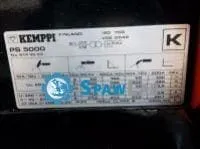
The Kemppi PS 5000 is an industrial multiprocess power source with a welding current up to 500 A, with 500 A at a 60% duty cycle and 390 A at a 100% duty cycle. You set the voltage steplessly from 10 V to 50 V. The set consists of a 400 V power source, an external FU series wire feeder and a WU 10 liquid cooling unit.
What this machine is for
On this power source you weld MIG/MAG with solid and flux cored wire, also in larger diameters, you weld with covered electrodes in the MMA method up to 6 mm, and you gouge with a carbon electrode under compressed air. One station therefore covers three jobs: joining, repair and removing material. When you gouge, you cut out welds with defects and prepare the edges for welding, which is regular work in a foundry and on repairs of heavy steel structures.
The base material is structural steel, also in large thicknesses. The 390 A at a 100% duty cycle gives multi run welds laid through a whole shift with no breaks for the power source to cool, and the 500 A at a 60% duty cycle is a reserve for passes with deep fusion and for larger diameter wires, where the feed speed is high. Once you add rollers for soft wire and a teflon liner in the feeder, you also weld aluminium alloys in the MIG method.
The buyer is a plant that makes heavy steel structures, a shipyard and an offshore company, a works building thick walled pipelines, a repair shop and a station that runs two or three shifts. In all of those the current at a 100% duty cycle counts, and so does the fact that the power source copes with dust and damp in the hall. The housing shields the power parts against knocks, and the inverter circuit holds the parameters under continuous load.
The set is modular: the power source, the cooling unit and the wire feeder are separate units linked by an interconnection cable. You move the feeder away from the power source and take it into a tank, onto scaffolding or between the ribs of a structure, while the heavy power module stays by the gas cylinder. This layout also shortens service downtime, because you replace one module and not the whole machine.
Typical uses are the production of heavy machines and building structures, the shipbuilding industry together with repairs of vessels, repair of castings and gouging with a carbon electrode, welding of thick walled pipelines and stations loaded through a whole shift. On top of that come robot cells, where the power source runs without breaks and has to hold repeatable parameters for many hours.
Features and equipment
- MIG/MAG welding with solid and flux cored wire. The power reserve also handles larger diameter wires, which you take to thick walled parts, and stepless voltage setting gives an arc from short circuit to spray.
- MMA welding with covered electrodes. The power source handles all kinds of covered electrodes up to 6 mm in diameter, including basic and cellulosic ones, so you take it into site assembly where you cannot set up a wire feeder.
- A high open circuit voltage. The arc strikes easily also on difficult electrodes, and you carry the pool in any position, including overhead and vertical.
- Electronic control of the current dynamics in the MMA method. The characteristic keeps the arc calm when the welder changes its length by hand, so the electrode sticks less on a short arc.
- Air carbon arc gouging. The current characteristic copes with the sudden load changes typical of gouging, so the power circuit takes no hits when the arc breaks, and material comes off quickly on repairs of castings.
- Stepless voltage control from 10 V to 50 V. With a potentiometer you tune the arc to the thickness of the material and to the welding position, with no jumps between steps, which makes it easier to stay within the parameters of the WPS welding procedure.
- Electronic arc stabilisation. The circuit follows the output parameters and reacts to voltage swings in the hall mains and to a change in wire stickout, so the arc stays focused and there is less spatter and less grinding after welding.
- An external FU series wire feeder. Four drive rollers guide the wire evenly also with a long torch and with flux cored wire, which limits jams in the liner and breaks in the arc.
- A WU 10 liquid cooling unit. The pump forces the circulation, heat leaves the torch neck and the contact tip, and its own flow cut out stops the work when a coolant hose is blocked, so the torch does not run dry.
- A modular build of the set. You move and service the power source, the cooling unit and the feeder separately, and you lay out the configuration of the set to suit the station and not the other way round.
- A housing made for the shop floor. It shields the power parts against knocks from trucks and against spatter, and the circuit copes with the dust and damp typical of an assembly yard.
- An inverter design with a large power reserve. It holds the settings under continuous load and on multi shift work, also when you weld very long multi run seams.
Technical data
| Brand | Kemppi |
|---|---|
| Power source type | inverter, multiprocess |
| Processes | MIG/MAG, MMA, air carbon arc gouging |
| Supply voltage | 400 V, three phase |
| Maximum welding current | 500 A |
| Current at a 60% duty cycle | 500 A |
| Current at a 100% duty cycle | 390 A |
| Voltage adjustment range | 10 V to 50 V |
| Voltage control | stepless, with a potentiometer |
| Covered electrode diameter | up to 6 mm |
| Cooling | liquid, WU 10 cooling unit |
| Wire feeder | external, FU series, four rollers |
What you get
- used Kemppi PS 5000 power source
- FU series wire feeder
- WU 10 liquid cooling unit
- set of interconnection cables
- liquid cooled welding torch
What to watch out for
The supply is 400 V, three phase. At currents up to 500 A the inrush current is high, so protect the connection with a time delay fuse and check the cross section of the supply cable and the state of the three phase socket. Liquid cooling needs attention: before you start, check the fluid level in the tank, the work of the pump, the flow and the tightness of the quick couplings, and change the fluid as the manufacturer advises. For gouging you need compressed air of the right output, a gouging torch and carbon electrodes, and the record does not list them. For aluminium you add rollers for soft wire and a teflon liner in the feeder.
The record does not state the version of the feeder, so confirm before you buy whether it is an FU 20 or an FU 30, because they differ in the drive mechanism and the set of rollers. It gives no weight and no dimensions, and the set has several parts, so arrange transport of the power source, the cooling unit and the feeder before collection and prepare a pallet and a truck. It does not give the lengths of the interconnection cables either, and they decide your reach at the structure, so ask about them together with the equipment.
How we sell used machines
This unit was checked in our service workshop in Krotoszyn with measurements to PN-EN 60974-4 and a load test. The price includes the first year of the basic service package: an inspection with cleaning of the machine and a validation measurement. Further years can be added. We ship across the European Union, collection in person by appointment.