


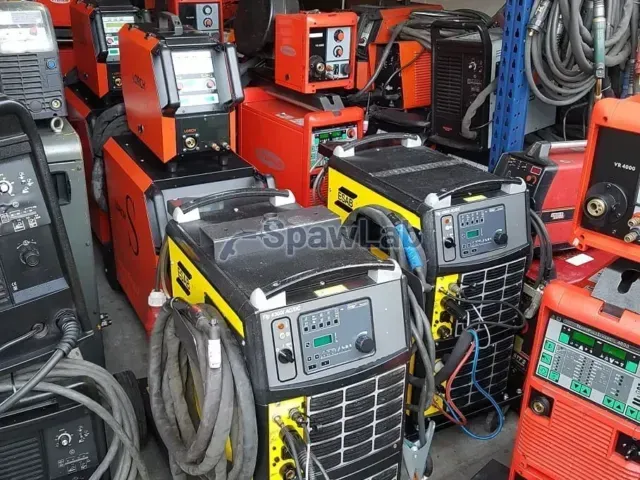


The Lorch V40 AC/DC is an industrial TIG power source for alternating and direct current, with an MMA mode. The documentation gives a TIG range from 3 to 400 A, 320 A at a 60% duty cycle and 250 A at a 100% duty cycle at 40°C. The supply is 3 x 400 V with a 32 A slow blow fuse, and the housing has class IP23.
What this machine is for
This is a power source for continuous work, where a stable arc at high currents counts. With alternating current you weld aluminium and its alloys, with direct current acid resistant, high alloy steel and titanium, and from 3 A you go down to thin walls. A duty cycle of 250 A at 100% means multi shift work with no breaks for cooling, and liquid cooling keeps the torch in check at currents above 250 A.
The maker aimed this machine at the building of chemical apparatus and acid resistant steel vessels, at aviation structures from aluminium and titanium, at the production of heat exchangers and high pressure pipelines, at repairs of injection moulds and at rebuilding of tool edges. The CAN-Bus port lets you tie the power source into an automated station.
The control rests on the SmartBase database, which matches the arc characteristic to the current and the material. In MMA mode you set the current from 10 to 400 A, so with one power source you handle precise TIG joints and the covered electrode in repairs.
The control works on fast timing adjustment of the IGBT transistors, so the arc keeps up with a change of its length. You see that in forced positions, where holding a steady pool depends on how the power source reacts to the shake of a hand. The result is less spatter and less rework after welding. A circuit that compensates voltage swings lets you work from a mains with a changing load and from a generator with AVR stabilisation.
Features and equipment
- SmartBase: a base of characteristics that drives the inverter in real time, matching a soft or a hard arc to the current and the material, which limits the risk of tungsten inclusions.
- Fast timing adjustment of the IGBT transistors: the arc reacts to a change of length, which matters in forced positions.
- MACCS, that is Master Aluminium Cycle Control: asymmetric shaping of the AC wave with separate adjustment of time and level for the positive and the negative half wave, to control the breaking of oxides and the load on the tungsten electrode.
- Alternating current frequency adjustment: focusing of the arc and narrowing of the heat affected zone on thin aluminium sheet.
- Tiptronic: a memory for 100 welding programs with a full set of parameters, gas flow times, current rise, pulse parameters and the ignition characteristic among them.
- Switching of jobs from the torch: you move between material thicknesses without breaking the arc.
- Pulse up to 20 kHz: the high frequency narrows the arc column, raises the energy density and the depth of fusion with less heat, and it also lowers the noise of the arc.
- Compensation of mains voltage swings: work from a generator of suitable power and with AVR stabilisation.
- MMA mode from 10 to 400 A: the covered electrode with no change of power source.
- CAN-Bus port: tying into automation and robot work at the station.
- Liquid cooling of the torch: at currents above 250 A the circuit holds a steady temperature of the torch head and extends the life of the wear parts.
- Optimised shielding gas flow: it matters on aluminium alloys and high alloy steels, where the shield decides the cleanliness of the weld.
Technical data
| Brand | Lorch |
|---|---|
| Model | V40 AC/DC |
| Current type | AC/DC |
| TIG welding range | from 3 to 400 A |
| MMA welding range | from 10 to 400 A |
| Duty cycle 100% at 40°C | 250 A |
| Duty cycle 60% at 40°C | 320 A |
| Welding current given in the data sheet description | 400 A and 360 A |
| Welding current in the data sheet attributes | up to 200 A |
| Mains voltage | 3 x 400 V |
| Mains fuse | 32 A slow blow |
| Protection class | IP23 |
| Pulse | up to 20 kHz |
| Program memory | Tiptronic, 100 programs |
| Cooling | liquid |
| Processes | TIG AC, TIG DC, pulse, MMA |
What to watch out for
The supply is three phase 400 V with a 32 A slow blow fuse, and protection class IP23, that is a station under a roof. The product data sheet gives a welding current up to 200 A, while the documentation of the model gives a range from 3 to 400 A in TIG and from 10 to 400 A in MMA, so confirm the version and the equipment of this piece before you buy. For work above 250 A you need a working cooling circuit and a torch matched to the current, and you check the fluid level and flow before the shift.
The menu with the Tiptronic memory and the AC wave adjustment takes a moment to lay out your own programs, but only then do you see the gain from repeatability. Before you buy, settle the set of tungsten electrodes, nozzles and liners and whether your station has a cooler of an output matched to this current class.
A pulse of a frequency up to 20 kHz changes the way you guide the torch: the arc is narrower and harder, so it suits narrow gaps and thin edges better than a soft arc, but it asks for practice. Adjustment of the balance and the frequency of the AC wave gives similar freedom on aluminium, only there the gain shows in the width of the oxide cleaning zone and in the wear of the electrode. If you weld in series, lay out the programs in the Tiptronic memory and assign them to given joints, because only then does switching jobs from the torch shorten the work instead of extending it.
This unit is sold
This machine has already gone to a customer. Similar units are listed below, and if you want the same model, leave your contact details in the form and we will let you know when the next one arrives.