


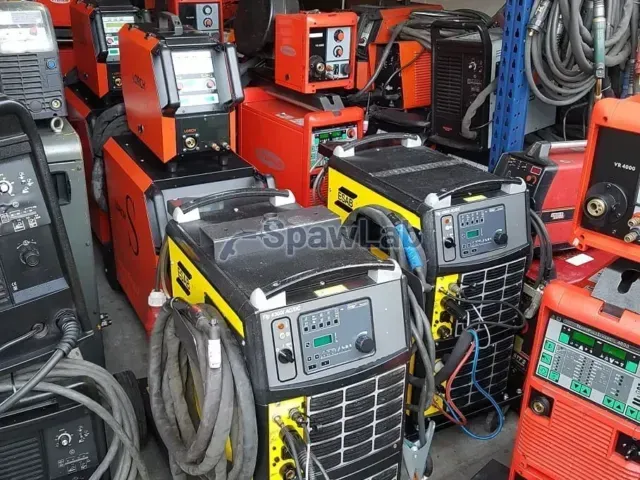

The Lorch V50 AC/DC is an industrial TIG power source for alternating and direct current, built on an inverter with digital control and an integrated liquid cooler. The supply is 3 x 400 V with a 32 A slow blow mains fuse, the protection class is IP 23S, and at a 100% duty cycle the machine gives 350 A. The whole set stands on a transport trolley.
What this machine is for
This is a power source for continuous work on thick walled structures and for automated bays. 350 A at a 100% duty cycle means welding without breaks forced by temperature, and the adjustment starts at 3 A, so with the same machine you also make tacks and thin edges. Digital process control is what gives repeatability, which matters in series production of components made to an approved procedure.
Alternating current takes aluminium alloys, direct current takes high alloy, acid resistant and mild steels. The documentation points this model to heavy industry, tank production and to aviation and automotive work. The applications listed are aluminium alloy structures in shipbuilding, heat exchangers and pipelines in acid resistant steel, series components for the chemical and food industry, repair work in power plants with covered electrodes, robot bays with a digital interface, reclamation of injection moulds and steel dies and the production of vehicle frames and chassis.
The third matter is integration. The LorchNet bus based on the CAN protocol links the source with wire feeders and with robots, it stands up to interference from the arc and lets you collect welding parameters remotely. This is a solution for robot cells and rotating jigs, in which the machine has to report parameters, and the arc alone is not what counts.
Features and equipment
- Integrated liquid cooling system (WUK): a closed circuit with a flow sensor holds the temperature of the torch at high currents, which extends the life of the consumable parts. The system needs a coolant of low electrical conductivity.
- Trolley type transport chassis: large wheels cope with an uneven floor, and the frame protects the electronics against knocks and dirt. You move the set together with the gas cylinder, but you will not carry it down stairs.
- Stand-by system: the fans and the pump start when the temperature calls for it, so the machine makes less noise, draws in less dust and goes for service less often. You cannot force the fans to run all the time by hand.
- LorchNet interface: a digital bus on the CAN protocol links the source with feeders and robots, resistant to electromagnetic interference from the arc. It needs the original communication cables.
- SmartBase parameter base: settings stored in memory for the method and the material, corrected in real time as the arc length changes, so the pool stays under control also in constrained positions. The base helps when you bring in new staff and when the range of parts changes often, and with unusual gas mixtures you correct the parameters by hand.
- Tiptronic memory: up to 100 sets of parameters called up from the panel or from the torch, so the welder works to approved WPS procedures without setting the machine from scratch. In series production of aluminium components made to a set procedure this is the basis of repeatability, but somebody has to manage those programs, because the memory is permanent and the jobs get untidy easily.
- LogiTIG: switching between currents without putting the arc out, with the button in the torch, that is a smooth move from heating to welding and a filled crater at the end of the bead. It takes practice with the button.
- Diagnostics and thermal protection: the circuit watches the input parameters and the IGBT power modules, on a phase loss or on overheating it stops the process and shows an error code.
- MACS process (Modulated AC System): modulation of the alternating current breaks up the oxides and at the same time limits the heat put into the material, so you weld thin aluminium sheet to a thicker part and keep the spread of the pool in check. The maker states that compared with plain TIG AC the number of production rejects drops by about 30%. The process needs the AC balance to be set by somebody who knows the alloy, which is why it pays to store the first settings in a program.
- High frequency pulsing up to 20 kHz: the arc narrows and its pressure rises, so the penetration is deeper, the arc is stable at low currents and the heat affected zone is clearly narrower, which matters on stainless steels. The function helps on tack welds and on edge welding, and at the highest frequencies the arc gives a high sound.
- Digital HF ignition: the arc strikes without touching the electrode, so the weld picks up no tungsten inclusions and the electrode lasts longer.
- Adjustment of AC balance and frequency: you set the duration of the positive and the negative half wave independently, that is the ratio of cleaning to penetration. At a high frequency the tungsten electrode wears faster.
Technical data
| Brand | Lorch |
|---|---|
| Model | V50 AC/DC |
| Type | industrial TIG inverter power source |
| Type of current | AC/DC |
| Lower welding current limit | 3 A |
| Current at 100% duty cycle | 350 A |
| Welding current given on the data sheet | up to 200 A |
| Supply voltage | 3 x 400 V |
| Mains fuse | 32 A slow blow |
| Minimum generator output | 25 kVA with AVR stabilisation |
| Protection class | IP 23S |
| Dimensions | 1130 x 450 x 815 mm |
| Cooling | liquid, integrated module |
| Program memory | Tiptronic, up to 100 jobs |
| Communication | LorchNet, CAN protocol |
| Special functions | MACS, pulse up to 20 kHz, HF, LogiTIG, SmartBase |
What to watch out for
The product data sheet gives a welding current up to 200 A, and the source description much higher values, also for a 60% duty cycle, so confirm this parameter on the rating plate before you buy, because the choice of torch and cables depends on it. We leave the disputed maximum current out of the table on purpose, so as not to repeat data the sheet does not confirm. The 3 x 400 V supply needs a power socket and a 32 A slow blow fuse. For work from a generator take a unit from 25 kVA with AVR stabilisation. The dimensions 1130 x 450 x 815 mm and the weight of the set with the cooler mean transport on a pallet truck, you will not carry the machine down stairs.
The cooling circuit needs a coolant of low electrical conductivity, plain water will destroy it, and the flow sensor stops the welding when the pressure drops. HF ignition spreads interference, so keep unshielded electronics away. The LorchNet bus works on original Lorch cables, count that cost when you extend the bay. The source description does not list a torch, an earth cable or a feeder, so confirm the content of the set before you buy.
This unit is sold
This machine has already gone to a customer. Similar units are listed below, and if you want the same model, leave your contact details in the form and we will let you know when the next one arrives.