


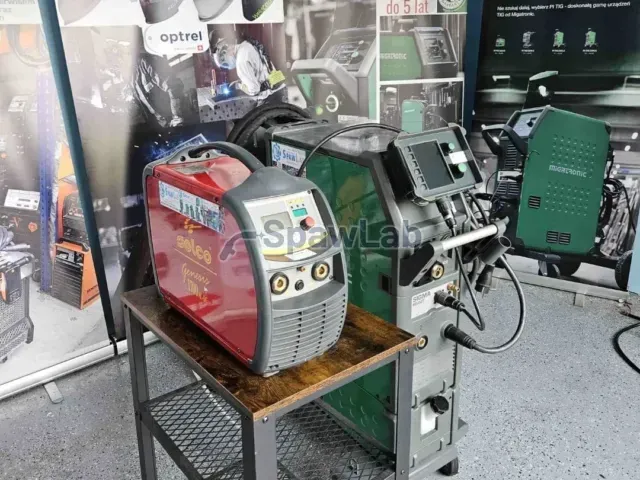


Selco Genesis 4000 GSM is an inverter multiprocess power source: MIG/MAG with pulse and double pulse, TIG DC with HF ignition and MMA. You set the current from 3 to 400 A, at 360 A the power source runs at a 100% duty cycle. It weighs about 37 kg and has a housing in class IP23S.
Today you get three processes from a single power source with the URANOS NX 4000 GSM (the site is in Polish).
What this machine is for
This is a power source for demanding production and fabrication, where several methods are welded at one station. MIG/MAG covers short and spray arc, pulse and double pulse and braze welding, TIG DC works with HF ignition without contact or with a Lift start, and the MMA mode handles covered electrodes with Hot Start, Arc Force and Anti-Stick adjustment. The range from 3 to 400 A goes very low, so you will handle both thin sheet and thick joints.
The duty cycle at 40°C and a 400 V supply is 60% at 400 A and 100% at 360 A. With a 230 V supply the values stay at 60% at 400 A and 100% at 360 A for MIG and TIG, and for MMA at 320 A. At 360 A you run long welds without breaks to cool the power source.
Pulse and double pulse come in useful on thin materials, stainless steel and aluminium with the right tooling, because they keep the heat in check and limit spatter. MIG braze welding helps on coated sheet, where a lower temperature protects the coating. TIG with HF ignition gives a clean start without touching the material with the electrode, which matters on stainless steel and on visible welds.
Double pulse adds a slower modulation on top of the base pulse. The pool grows and cools in turn, so the face lays in regular ripples, much as with TIG. Beyond the look this gives a lower heat input per unit length of weld, so thin sheet ripples less, and on aluminium it is easier to keep control of the pool in fixed positions.
The Green@wave system with power factor correction runs at a factor close to one. In practice that means a lower current drawn from the mains at the same welding power and less load on the installation, which matters where several stations hang on one distribution board. The digital control gives repeatable parameters at the same time, and the program memory shortens the changeover between parts.
Features and equipment
- Multiline Three Level inverter technology and the Green@wave system with power factor correction, power factor about 0.95.
- MIG/MAG in short and spray arc mode, with pulse, double pulse and braze welding.
- TIG DC with HF ignition without contact and with a Lift start.
- MMA with adjustable Hot Start, Arc Force and Anti-Stick functions.
- Digital control based on software, an iPanel with a graphic display on WF series feeders.
- Memory of welding programs, the description gives 64 user locations.
- A Selco CAN bus for internal communication and an Ethernet port for work with Weld@Net software.
- Prepared for work with a robot after an RI WA or RI XP interface is added.
- A housing in plastic resistant to knocks and high temperature, potted printed boards and ventilation ducts that shield the inside from dust.
- A variable speed fan, it runs when it is needed, so less dust gets inside.
- Prepared for liquid cooling, with a cooling unit added you work with a liquid cooled torch at the upper settings.
In MMA mode the machine gives three adjustments that decide how the electrode works. Hot Start boosts the current at the start, so the electrode strikes without sticking to the material. Arc Force adds current at the moment a droplet shorts the arc, so the arc does not go out when the electrode is held short. Anti-Stick cuts the current when the electrode does stick, so it does not glow red and ruin the coating. Together they give calm work on basic and rutile electrodes.
Technical data
| Brand | Böhler Welding, a machine from the Selco family |
|---|---|
| Model | Genesis 4000 GSM |
| Type | inverter power source, multiprocess |
| Welding processes | MIG/MAG in short and spray arc, pulse, double pulse, braze welding, TIG DC with HF and Lift start, MMA |
| Supply voltage | 3 x 400 V or 3 x 230 V, 50/60 Hz |
| Recommended slow blow fuse | 25 A at 400 V, 45 A at 230 V |
| Current range in all processes | from 3 to 400 A |
| Duty cycle at 40°C and 400 V | 60% at 400 A, 100% at 360 A |
| Duty cycle at 40°C and 230 V | 60% at 400 A, 100% at 360 A for MIG and TIG, 320 A for MMA |
| Open circuit voltage | 73 V |
| Power factor | about 0.95, Green@wave system with power factor correction |
| Control | digital, based on software, iPanel with a display |
| Program memory | 64 user locations |
| Internal communication | Selco CAN bus |
| External communication | Ethernet, Weld@Net software |
| Work with a robot | after an RI WA or RI XP interface is added |
| Housing protection class | IP23S |
| Insulation class | H |
| Cooling | liquid, cooling unit as a separate module, for example Selco WU 3000 |
| Wire feeder | external, for example Selco WF 2000, WF 3000 or WF 4000 |
| Dimensions (l x w x h) | 690 x 290 x 510 mm |
| Power source weight | about 37 kg |
What to watch out for
The power source runs on 3 x 400 V or 3 x 230 V at 50/60 Hz, with a slow blow 25 A fuse at 400 V and 45 A at 230 V. You check the voltage version on the rating plate, because the circuit protection depends on it. The open circuit voltage is 73 V. The housing has class IP23S, that is protection against dust and water falling at an angle and approval for places with a raised risk of shock.
This is the power source alone, so for wire welding you need an external WF series feeder along with an interconnection cable, and the iPanel is part of the feeder. The record gives liquid cooling, the cooling unit was a separate module, the description points to Selco WU 3000, so you check that it is there and check the coolant level. Work in a network needs Weld@Net software, and work with a robot an RI WA or RI XP interface, and you settle the availability of both separately. A weight of about 37 kg at dimensions of 690 x 290 x 510 mm lets two people carry the power source alone, but the whole station with a feeder, cooling unit and trolley weighs much more.
Work in several processes also means several sets of accessories. For TIG you need a torch with a valve or with control, tungsten electrodes and argon, for MIG/MAG rollers matched to the wire and a gas mix, for MMA an electrode holder. With pulse the right program counts, so check which curves the feeder panel has loaded and whether they suit the wires and gases you work with in the workshop.
This unit is sold
This machine has already gone to a customer. Similar units are listed below, and if you want the same model, leave your contact details in the form and we will let you know when the next one arrives.